Anno 2026
Nostradamus.
What the Centuries actually say.
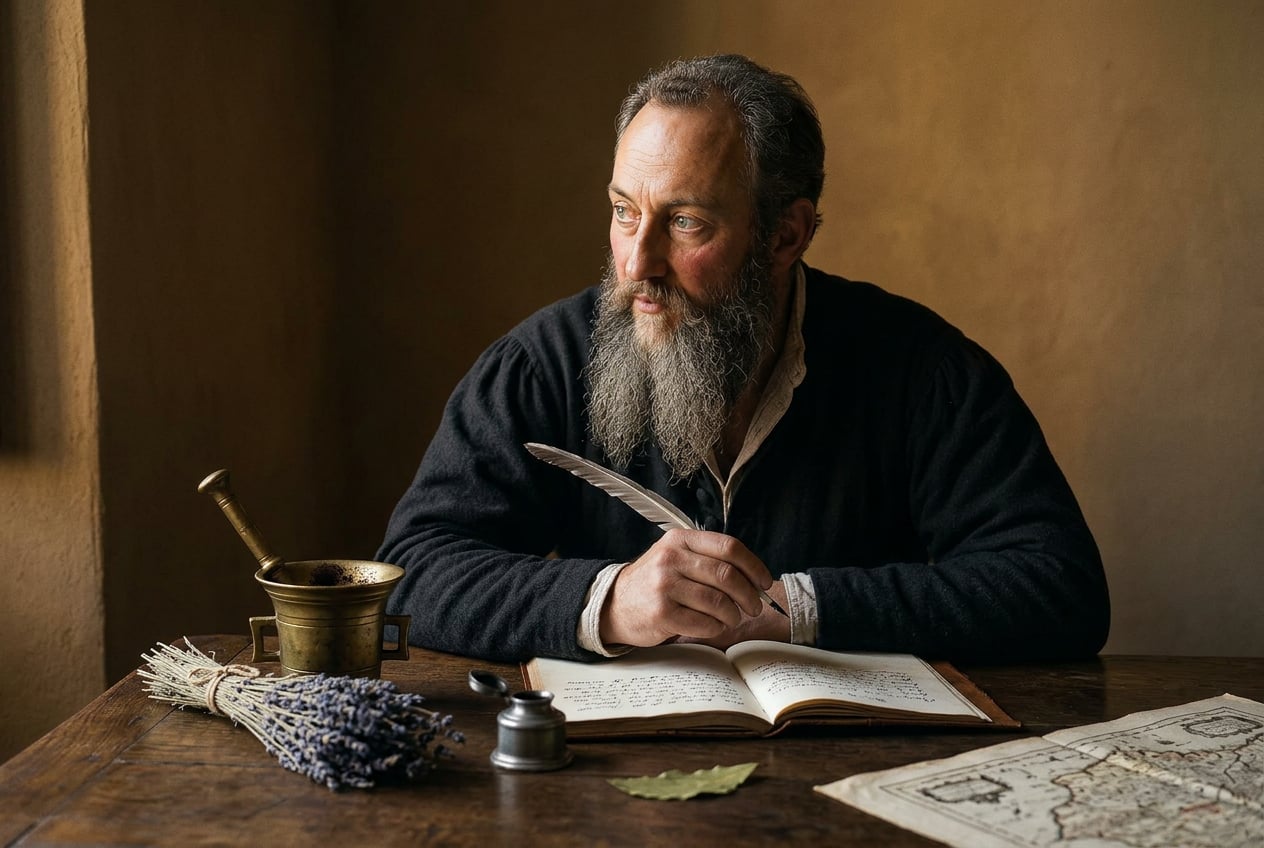
A typesetting error from 1568 is what made the twentieth century's most famous Nostradamus reading possible.
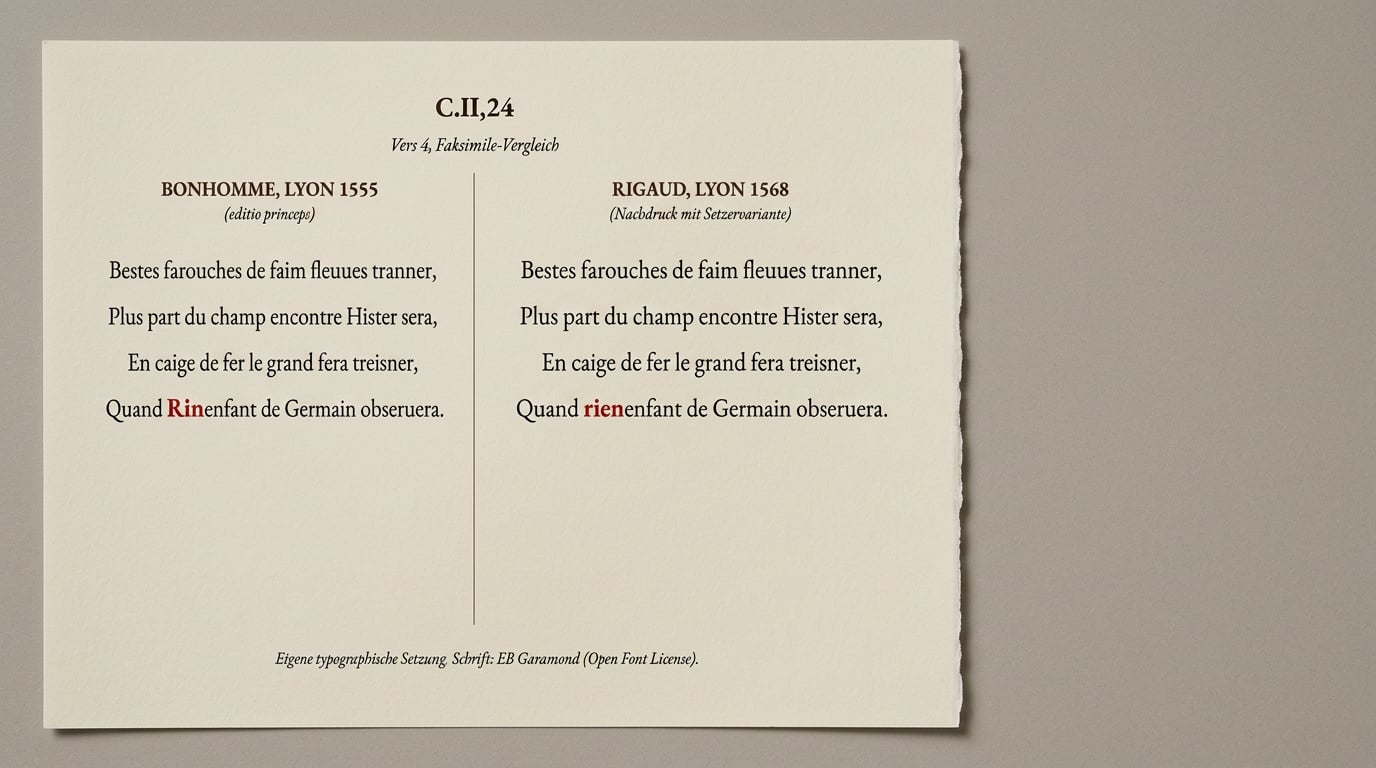
In 1555, Macé Bonhomme prints the first four Centuries in Lyon. In the fourth line of quatrain C.II,24 the word is Rin, the old name for the Rhine. In 1568, Benoist Rigaud reprints the quatrain. His compositor no longer recognises the old Rin and replaces it with rien, meaning nothing.
The quatrain loses its second geographic anchor. What stays is Hister, the old name for the Danube. Out of that isolated Hister, the twentieth century built the most famous political reading of Nostradamus there is. The first edition carried a different place name. Popular tradition lost it.
The book shows the two prints side by side in facsimile and reads the quatrain in the cluster of its neighbours.
What is on display
At the centre of this work stand 944 quatrains, first printed in Lyon between 1555 and 1568, and the life of the man who wrote them: Michel de Nostredame, apothecary in Salon-de-Provence, 1503 to 1566.
Three forms grow out of the same source work. A novel in the first-person voice of the seer, as Volume I. A non-fiction title with a workshop apparatus, as Volume II. An iOS app that opens up the Nostradamus corpus in full and carries 34 further prophetic traditions along with it. The app ships in the coming weeks, both volumes in autumn 2026.
The work in two volumes
The Life.
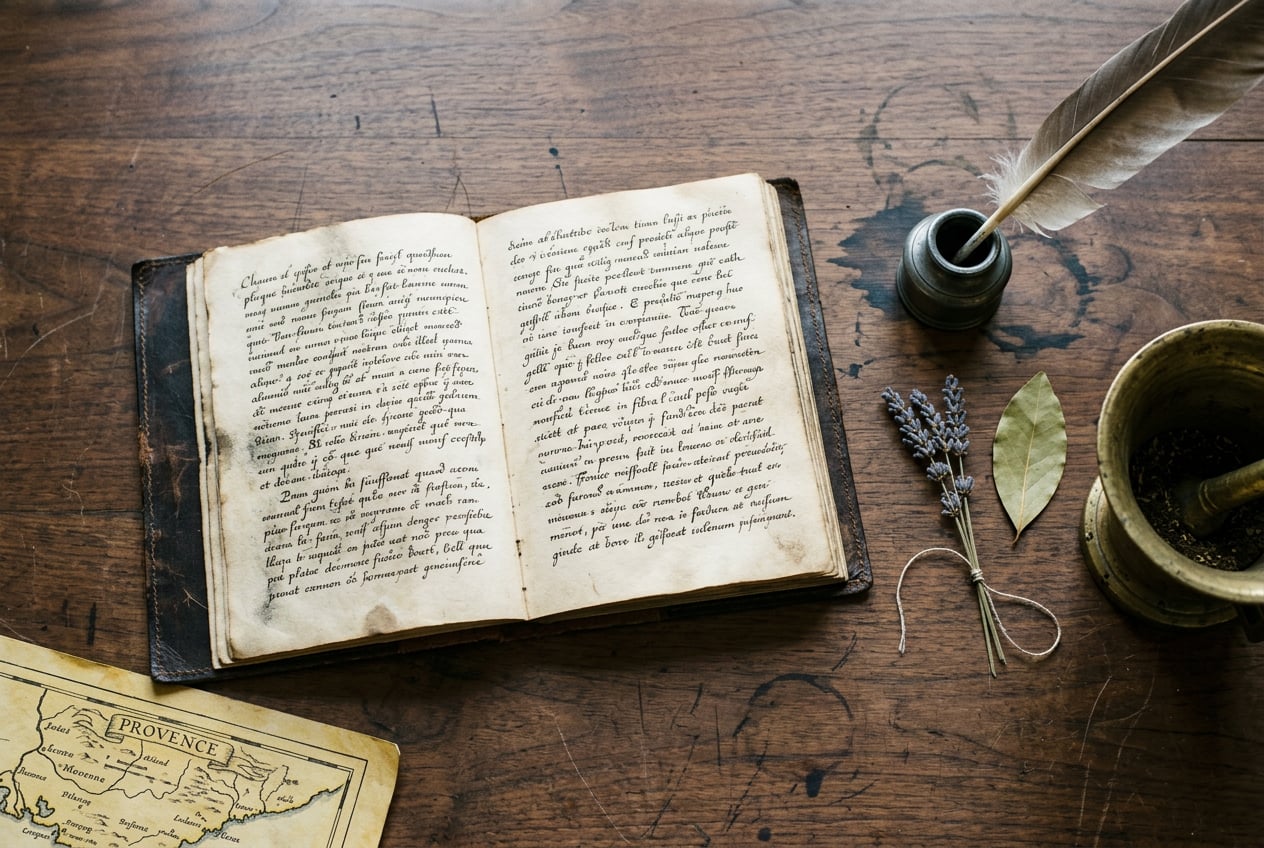
Follows Nostradamus from Saint-Rémy to Salon, in his own voice. Salon-de-Provence, the plague, the apothecary apprenticeship, the court negotiations with Catherine de' Medici, the dropsy in the spring of 1566. Built on notarial records, parish registers, letters, and the contemporary accounts by Chavigny and César de Nostredame. With its own apocryphal chapter, which checks the cited lines against the facsimiles of the Lyon first editions of 1555, 1557, and 1568.
The Cycles.
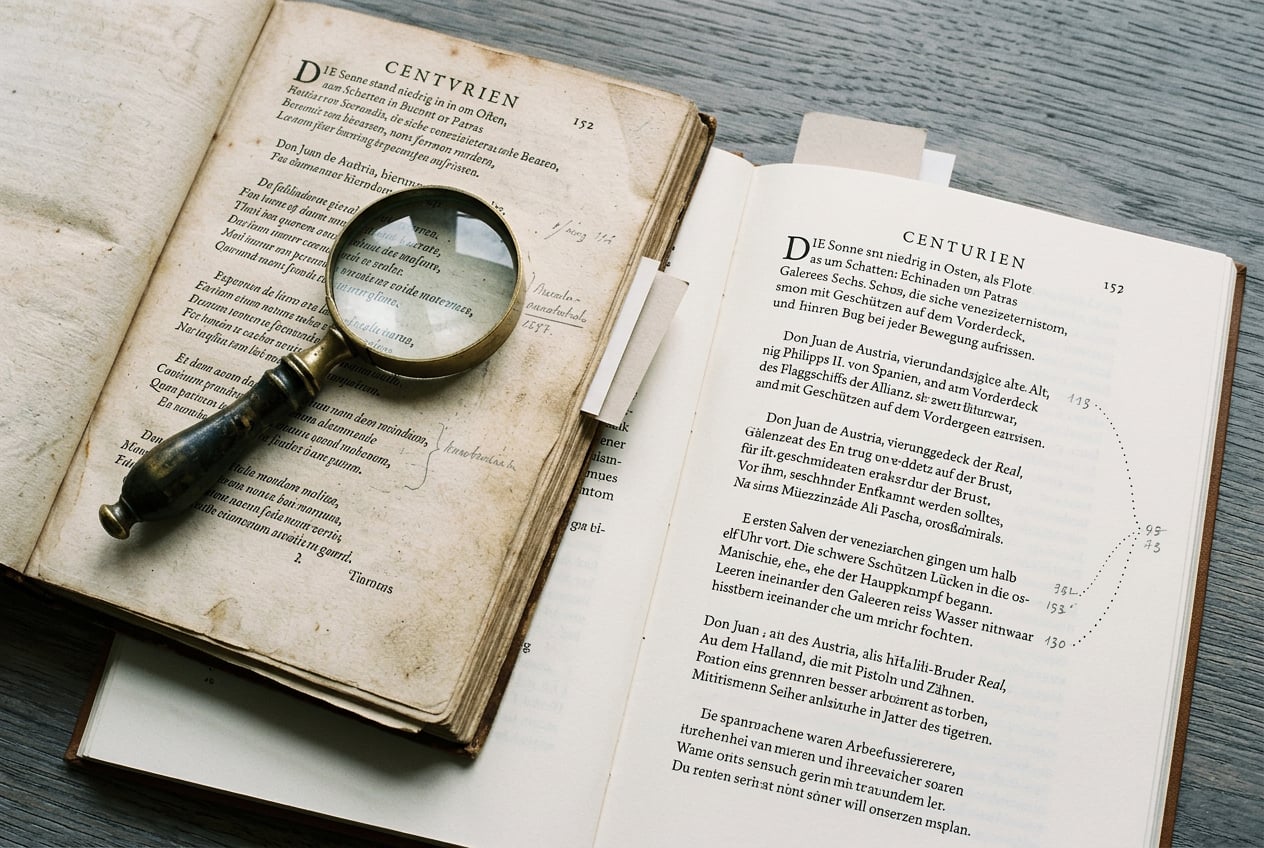
Reads the Centuries thematically: iron from the north, the harbour of the crescent, Vienna, the monk in grey, Navarre, the German mountains, the long sermons, the Seven Ages, anagrams and codes, plague and the healing arts. Every line in the context of the surrounding quatrains, with a workshop apparatus that shows how four centuries of reception have shifted the readings.
Method
-
Facsimile verification
Every cited line is held against the Lyon first editions: Macé Bonhomme 1555 (Centuries I to IV, Albi copy), Antoine du Rosne 1557 (Centuries V to VII, Utrecht copy), Benoist Rigaud 1568 (Centuries VIII to X, BnF Gallica bpt6k792600). Eight typesetting variants that change the meaning are documented.
-
Cluster reading
No line stands alone. Every quatrain is read in the context of the ten to fourteen surrounding quatrains.
-
Method-aware sorting
Every line treated is filed into one of four drawers: detail hit, plausible reading, retrospective update, apocryphal.
The findings
- 944
- quatrains verified in full against the facsimiles.
- 628
- documented collation entries on variants between first print and Rigaud reprint.
- 8
- typesetting variants that shift the meaning, each treated in its own workshop block in the book. The most consequential is Rin / rien in C.II,24.
- 4
- detail hits that hold up under cluster reading. Spread across the 16th and 18th centuries, each unpacked individually in Volume II.
- 5
- popular readings that do not hold up under cluster reading. Each with its own workshop block. The most consequential one is hinted at in the hook above.
Tone samples
"In April 1566, my belly swelled in a way I recognised from my own apothecary books as dropsy, before I admitted it to myself in the mirror. The belly grew firm and yielding at the same time, the shirt no longer closed, breathing became short whenever I leaned at the table. In my legs the gout, which had been making its attacks for years, now joined the dropsy into a single condition. I laid my hands on my belly and knew that I was dying."
Volume I, Chapter 17, Upright in the wall.
Volume II · workshop on a quatrain from Century II
Bonhomme 1555, Albi copy: a topographic proper name. Rigaud 1568, BnF Gallica: an everyday word. Out of this deletion, the twentieth century made one of the most famous Nostradamus readings of all. Which one, and with what consequences, the workshop block lays out.
Prophetie · the database
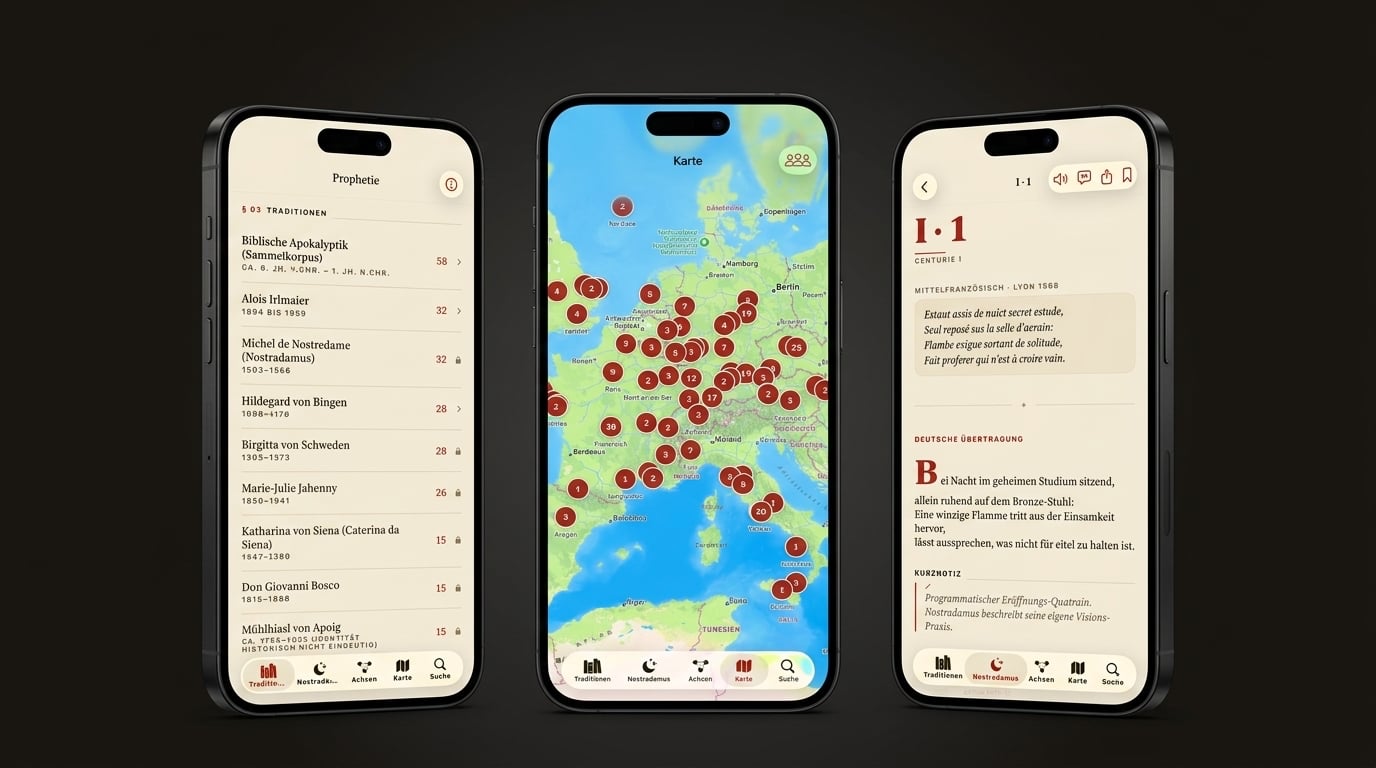
Out of the workshop apparatus to the work, a free-standing source database has grown that reaches further than the work itself. Prophetie, an iOS application, opens up the Centuries corpus and 34 further prophetic traditions from original sources, with a full source apparatus. An academic reference tool for a body of literature that is widely cited and rarely read in the original.
What is in it
The complete Centuries corpus, all 944 quatrains in the Middle French wording of the Lyon first editions, with our own German translation. Around it sit 606 curated schema scenes from 35 prophetic traditions: biblical apocalyptic literature, the Sibylline books, Hildegard of Bingen, Joachim of Fiore, Vincent Ferrer, Pseudo-Methodius, Anne Catherine Emmerick, Marie-Julie Jahenny, the Bavarian seers Mühlhiasl and Stormberger, and more. Nostradamus is the most extensive voice in a larger choir.
Source apparatus
As of 2026, 927 of 944 Centuries quatrains are verified against the Lyon first edition by Benoist Rigaud, 1568, in the Gallica holdings of the Bibliothèque nationale de France (ARK bpt6k792600). Every line carries a visible confidence flag. More than 540 historical readings are framed as reception history, not as proof: Le Pelletier 1867, Pitra 1882, Reeves 1969, Cohn 1957, McGinn 1985, and others, each cited with author, year, and main thesis, without reproducing the secondary text. Every tradition has at least one methodology card that lays out transmission, scribes, editors, and source-critical reservations.
Reading tools
Full-text search with highlighting across all 944 quatrains. A glossary of 54 key terms with a concordance over all occurrences. A map with 135 geocoded places and filterable axes. Topical tags. Two-way cross-references. Per-entry citation export (BibTeX, RIS, Zotero RDF) for further use in academic writing. Optional AI research via the Anthropic API directly, with no tracking layer in between.
What Prophetie is not
Not a prediction engine. Not a verdict on the truth or fulfilment of any prophecy. Not a reproduction of secondary literature, but a methodical citation of it under German copyright law (§51 UrhG). Not an article of faith and not a recommendation, but a reading and research tool for a body of literature four hundred years old.
Available for iOS 17 or later in the App Store, worldwide. One-off purchase, EUR 14.99. No subscription, no in-app purchases, no tracking, no ads.
Edition specs
- Format
- Hardcover, 13.5 × 21.5 cm
- Length
- Volume I, 376 pages. Volume II, 168 pages.
- Typography
- EB Garamond, classical novel setting
- Plates
- Facsimile plates from Bonhomme 1555, Du Rosne 1557, Rigaud 1568, and Wellcome 1605
- Apparatus
- Workshop block in every chapter, separate appendix with a name index, glossary, and bibliography
- Languages
- German first. English and French editions in preparation.